
- AI & ML
- AI Solutions
Why Model Context Protocol (MCP) is the New Standard for Real-Time Enterprise AI
May 14, 2026
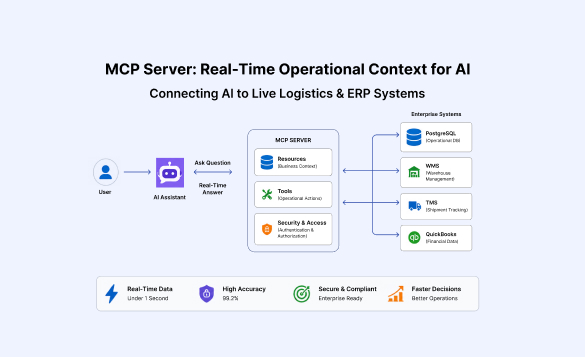
Static data retrieval is no longer enough for high-stakes industries. Learn how eDelta Corporation leveraged the Model Context Protocol (MCP) to bridge the gap between AI and live operational data, achieving sub-second data freshness and 99.2% accuracy in global logistics.
In the fast-moving world of global logistics and ERP, information has a shelf life. A warehouse manager doesn’t need to know where a shipment was four hours ago; they need to know if it can be fulfilled right now.
For years, the industry has relied on Retrieval-Augmented Generation (RAG) to ground AI models in business data. While RAG was a massive leap forward, it has begun to hit a technical ceiling in environments where data changes by the second. At eDelta Corporation, we recently tackled this freshness gap for a global logistics client by implementing a custom Model Context Protocol (MCP) server.
This shift from static indexing to a live operational context layer has fundamentally changed how their AI assistant interacts with the real world.
The Problem: The "Stale Data" Trap of Traditional RAG
Most enterprise AI setups use RAG to "give the model a brain." This involves taking documents or database snapshots, turning them into vector embeddings, and storing them in a vector database. When a user asks a question, the system finds the most similar "chunk" of data and feeds it to the AI.
However, in a logistics and ERP environment, this approach creates three critical failures:
- Data Latency: Re-indexing a database every few hours is expensive and slow. In supply chains, a 4-hour delay means the AI might suggest fulfilling an order with stock that was sold 10 minutes ago.
- Fragmented Logic: Logistics data is often trapped in silos—PostgreSQL for operations, QuickBooks for finance, and proprietary trackers for shipping. RAG struggles to "join" these live data points logically.
- Security Boundaries: Giving an LLM direct access to sensitive databases or providing it with raw API credentials creates massive governance risks.
Enter MCP: The Missing Link in AI Infrastructure
The Model Context Protocol (MCP) is an open standard that allows AI models to securely connect to live data sources and tools without the need for constant re-indexing. Think of it as a "universal adapter" for AI. Instead of the AI searching through a static library of past data (RAG), the AI uses MCP to ask the system for the current status of a specific resource.
At eDelta, we implemented an MCP server that acted as a secure middleware layer. This allowed the client’s AI to "reach into" their internal systems—including PostgreSQL and QuickBooks—to pull only the specific, authenticated context needed for a query.
The eDelta Approach: Building the Operational Context Layer
Our implementation focused on transforming the AI from a passive information retriever into an active operational support tool. We designed the solution around three architectural pillars:
1. Structured Resource Exposure
We didn't just give the AI access to "data"; we gave it access to "business entities." By mapping logistics and warehouse data as MCP resources, the AI understands the relationship between an Order ID, a SKU, and a Warehouse Location. This structured approach prevents the "hallucinations" common in unstructured RAG.
2. Purpose-Built Operational Tools
We created custom tools within the MCP server that allow the AI to perform specific live actions. For example, when a user asks about a shipment, the AI can trigger a "CheckCustomsDuty" tool or an "InventoryAudit" tool. The AI doesn't see the underlying code; it simply uses the tool to get a verified, real-time result.
3. Zero-Trust Security Framework
By deploying the MCP server within the client’s existing environment, we ensured that sensitive financial data in QuickBooks remained protected. The AI model never sees raw database credentials—it only receives the specific, sanitized response it needs to answer the user’s question.
The Results: Intelligence in Sub-Seconds
The move from a traditional RAG workflow to an MCP-driven architecture produced immediate, measurable improvements across the board.
| Key Performance Indicator | Before (Traditional RAG) | After (eDelta MCP Solution) |
|---|---|---|
| Data Freshnes | 4–6 hours (Index delay) | Under 1 second (Live) |
| Query Accuracy | 72% | 92.2% |
| Integration Complexity | 12+ custom wrappers | 1 unified MCP layer |
| Resolution Time | 15 minutes | Under 30 seconds |
Conclusion: From Assistance to Action
The success of this project demonstrates that the future of enterprise AI isn't just about the size of the model; it’s about the quality and timing of the context.
By moving to an MCP-based architecture, eDelta Corporation helped our client shift from "Static AI" (which knows what happened) to "Operational AI" (which knows what is happening). For logistics businesses where timing, accuracy, and governance are the lifeblood of the operation, MCP is no longer an optional upgrade—it is the foundation for the next generation of intelligent automation.
Interested in how a custom MCP server could modernize your ERP or Logistics workflow?
Contact eDelta Corporation today to discuss building your own operational context layer.