
Building a Real-Time Operational Context Layer with MCP
Custom Model Context Protocol Infrastructure for Enterprise Logistics
Executive Summary
Modern enterprise AI is most effective when it has access to current, trusted business context. In logistics and ERP environments, where inventory, shipment status, warehouse capacity, and financial records change constantly, static knowledge retrieval is often not enough. AI models may be able to answer general questions, but they struggle when the answer depends on live operational data.
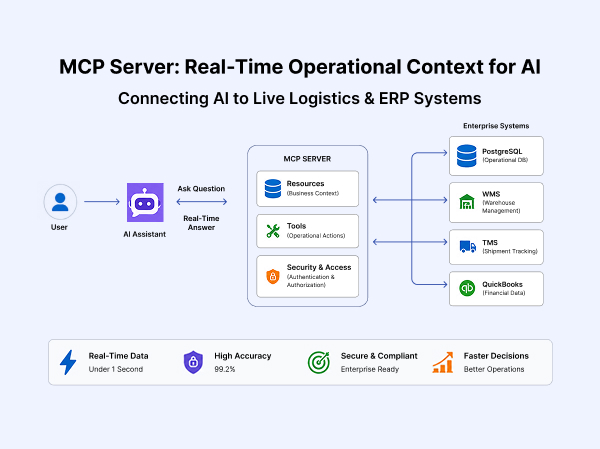
For a mid-to-large-scale logistics client, eDelta Corporation designed and implemented a custom Model Context Protocol (MCP) server to address this gap. The MCP layer acted as a secure bridge between the client’s AI assistant and internal business systems, allowing the model to request real-time context without direct access to databases or sensitive credentials.
This approach enabled the client to move beyond traditional RAG-based workflows and create a more reliable, secure, and operationally relevant AI experience.
Business Challenge
The client’s operations depended on multiple systems working together, including warehouse management, shipment tracking, inventory records, and financial data stored in QuickBooks. While each system served its own purpose, the information was fragmented and difficult for AI to use in a unified way. This created several challenges.
First, the AI assistant could retrieve general information, but it could not consistently answer live operational questions such as whether an order could be fulfilled today or whether stock was available in a specific warehouse.
Second, the existing RAG-based approach depended on indexed or synchronized data, which was often outdated by the time a question was asked. In a logistics environment, even a small delay in data freshness can lead to incorrect answers and poor operational decisions.
Third, the client had strict security and compliance requirements. Raw database access could not be exposed to an AI model, and any solution had to respect enterprise authentication, authorization, and governance standards.
The business needed a way to connect AI to live context in a controlled and scalable manner.
Solution Approach
eDelta implemented a custom MCP server to serve as the operational context layer between the AI model and the client’s internal systems. Rather than building multiple one-off integrations, the team used MCP as a standardized framework for exposing the exact context and actions the AI needed.
The solution was designed around three key elements.
Structured context exposure
Relevant logistics and warehouse entities were exposed as MCP resources, allowing the AI to understand the available business context without directly accessing the underlying systems.
Purpose-built operational tools
Custom MCP tools were created for live business actions such as fetching inventory, checking order readiness, and calculating customs duty. This gave the AI a controlled way to request operational data at the moment it was needed.
Secure enterprise access
The MCP server was deployed inside the client’s environment and connected to enterprise authentication controls. This ensured that sensitive data remained protected and that all access stayed within the client’s governance framework.
Implementation
The MCP server was integrated with the client’s PostgreSQL-based operational systems and QuickBooks API. The architecture was designed to support both high-reasoning AI models and smaller private models, depending on the workflow and deployment needs.
A typical request followed a simple but effective flow. When a user asked, “Can we fulfill Order #882 today?”, the system authenticated the request, checked live inventory, reviewed warehouse and delivery constraints, and returned a structured response to the AI model. The model then generated the final answer using current operational data rather than stale indexed content.
This made the AI assistant more accurate, more useful, and more aligned with real business operations.
Results
The implementation delivered measurable improvements across speed, accuracy, and integration complexity.
| Key Performance Indicator | Before eDelta | After eDelta |
|---|---|---|
| Data Freshnes | 4–6 hours | Under 1 second |
| Query Accuracy | 72% | 92.2% |
| Integration Complexity | 12+ custom wrappers | 1 unified MCP layer |
| Resolution Time | 15 minutes | Under 30 seconds |
Business Impact
The project helped the client shift from static AI assistance to real-time operational intelligence. Teams could now ask business questions in natural language and receive answers grounded in live logistics and finance data.
This reduced manual checking, improved decision-making speed, and strengthened confidence in AI-generated responses. It also created a more maintainable integration architecture for future AI use cases, since new tools and workflows can now be added through the same MCP foundation.
Conclusion
This project demonstrated how MCP can be used to connect AI systems with real-time enterprise operations in a secure and structured way. For a logistics business where accuracy, timing, and governance are critical, eDelta Corporation delivered a solution that transformed AI from a passive information assistant into a reliable operational support layer.